
Know-How for European Chemicals Focal Points
Project duration: 15/02/2025 – 30/04/2027
Project volume: 279.569,77 EUR
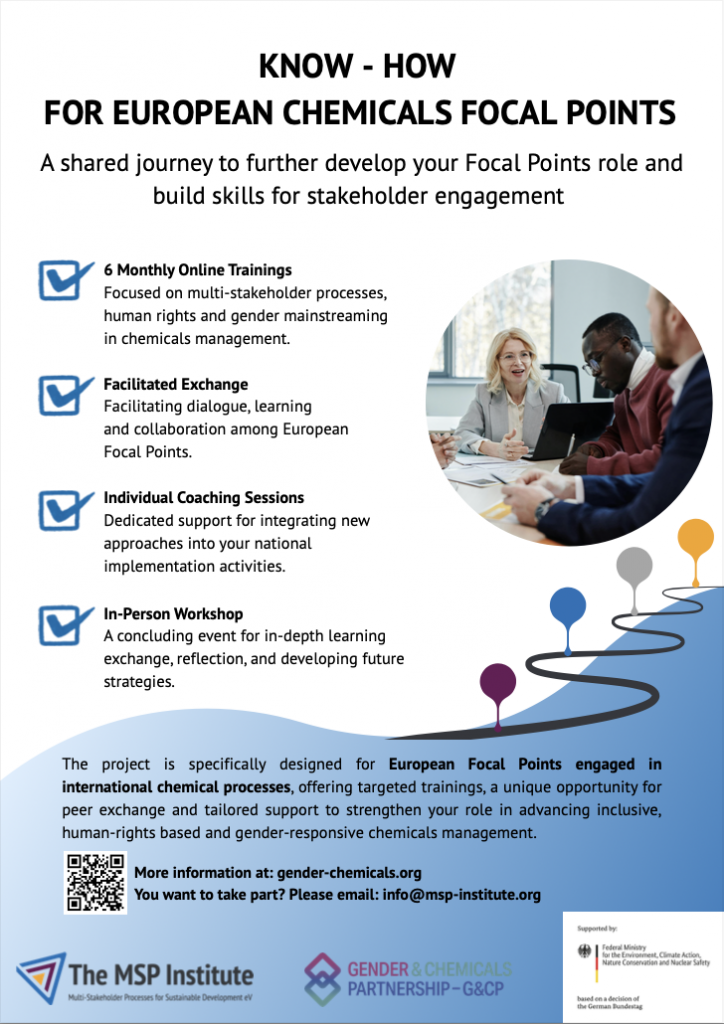
The project aims to minimise the negative environmental and health impacts of hazardous chemicals by better integrating the needs and expertise of all relevant stakeholders into chemicals management in Europe and promoting their equal cooperation. To this end, the expertise of National and NGO Focal Points of the Global Framework on Chemicals and the Intergovernmental Science-Policy Panel on Chemicals, Waste and Pollution is to be strengthened through training on multi-stakeholder processes with a human rights focus. In addition to promoting skills for stakeholder participation and cooperation, the project also aims to raise awareness of gender-specific risks and teach skills for taking gender aspects into account in chemicals management. The project focuses on online training and a final workshop and offers the focal points networking and exchange opportunities and supports implementation at national level. Learning successes, implementation experiences and best-practice examples are recorded and made available to all relevant stakeholders in chemicals management for long-term use.
The MSP Institute is supported by the Gender & Chemicals Partnership (G&CP), and in particular the G&CP Working Group on ‘Education & Training’, in the various activities to achieve the project outputs.
The project is financially supported by the European Environmental Initiative (EURENI) of the German Federal Ministry for the Environment, Climate Action, Nature Conservation and Nuclear Safety (BMUKN).
G&C Knowledge Platform
Project duration: 01/09/2025 – 31/03/2027
Project volume: 119,792.90 EUR
Women and girls are disproportionately affected by exposure to toxic substances in air, water, and soil due to economic, social, and physiological factors. As part of addressing the global pollution crisis, it is therefore crucial to systematically integrate gender perspectives to ensure sustainable chemicals management. To support this aim, the project seeks to create a new platform that brings together research, gender-specific data, and practical tools on the links between gender and chemicals: the Gender & Chemicals Knowledge Platform. The platform will provide comprehensive and accessible information for relevant stakeholders and the wider public, including guidance on gender-responsive chemicals policy, curated tools and training resources on gender mainstreaming, and thematic fact sheets. Promoted through online events and social media, it is designed to foster exchange, mutual learning, and cross-sectoral collaboration on gender aspects of the pollution crisis in Germany and internationally – and to continue supporting this work beyond the project’s duration.
The MSP Institute implements the project with the support of the Gender & Chemicals Partnership (G&CP), particularly its Working Group on ‘Gender Data & Information’.
The project is funded by the German Environment Agency (UBA) and the German Federal Ministry for the Environment, Climate Action, Nature Conservation and Nuclear Safety (BMUKN).
Project News
Gender & Chemicals Knowledge Platform Launches to Advance Gender-Responsive Chemicals Management
New digital platform consolidates global knowledge on chemicals and gender equality
The first global platform dedicated to consolidating knowledge on the intersection of gender, chemicals, and pollution is now publicly available, providing free access to research, policy resources, and practical tools for stakeholders worldwide.
The Gender & Chemicals Knowledge Platform officially launched on 21 July 2026 as a new global resource dedicated to advancing knowledge on the intersection of gender, chemicals, and pollution. Developed by the Gender & Chemicals Partnership (G&CP), the platform serves as a central hub for researchers, policymakers, NGOs, and others working at the intersection of environmental health and gender justice, providing access to research, policy resources, and practical tools to support gender-responsive chemicals management worldwide.
The platform was developed through the collaboration of international experts and partner organizations working to strengthen gender-responsive chemicals and waste management at global, regional, and national levels.