

Reflections on Three Years of Multi-Stakeholder Collaboration
From aspirin to heart medication, studies repeatedly show that sex-specific differences play a role in the effects and side effects of medicines. However, what is increasingly recognised in healthcare also applies to chemicals more broadly: their effects can differ according to sex. Yet data and knowledge about sex-specific exposures and impacts are still lacking in many areas. This is why the Gender & Chemicals Partnership was established in 2023 to promote gender-responsive chemicals management internationally. Three years later, we reflect on initial activities, challenges and achievements.
Chemical exposure is not gender-neutral. Biological differences — for example, in hormone levels or body fat distribution — can influence the effects of chemicals. Some substances even have sex-specific effects; for instance, certain endocrine disruptors have been linked to breast cancer in women and testicular cancer in men. Social factors also play a role: the gender-based division of labour in the workplace and at home leads to different exposure pathways. Anyone seeking to effectively reduce chemical risks must take these differences into account, for example in risk assessments, hazard communication and occupational health and safety. Nevertheless, knowledge remains incomplete, and sex-disaggregated data — that is, data collected and analysed separately by sex — as well as research in this area are still lacking in many cases.
From Political Commitments to Practical Implementation
The link between gender equality and chemicals management has been recognised at the political level since the 1995 Beijing World Conference on Women. In recent years, the issue has gained greater attention through the engagement of women’s organisations and the adoption of feminist foreign policy approaches. The Basel, Rotterdam and Stockholm Conventions, the Minamata Convention on Mercury, and the Global Framework on Chemicals (GFC) all provide for the development of national and international gender action plans. The principle of gender equality is also firmly embedded in the GFC.
Similar discussions are taking place in the ongoing process to establish the Intergovernmental Science-Policy Panel on Chemicals, Waste and Pollution (ISP-CWP). The need to implement gender-responsive chemicals management has therefore long been recognised. In practice, however, it remains the exception rather than the rule. What is needed is a systematic approach to implementation across sectors and stakeholders that addresses knowledge gaps and uses gender as an analytical category to make policy measures more effective.
At the same time, progress is unfolding in a difficult political climate. Anti-gender movements are gaining strength, programmes promoting women and gender equality are being cut in numerous countries, and securing binding commitments to integrate gender considerations into international negotiations is becoming increasingly difficult. Additionally, chemicals management is competing with multiple global crises for attention and resources. In this environment, organised cooperation across stakeholder groups is becoming increasingly important. It provides continuity and support for an issue that could otherwise easily be pushed off the political agenda. This is why the Gender & Chemicals Partnership (G&CP) was established at the fifth International Conference on Chemicals Management (ICCM5) in Bonn in 2023. The partnership works internationally to strengthen gender equality and promote the role of women and girls in chemicals and waste management.
Growing Together, Creating Impact
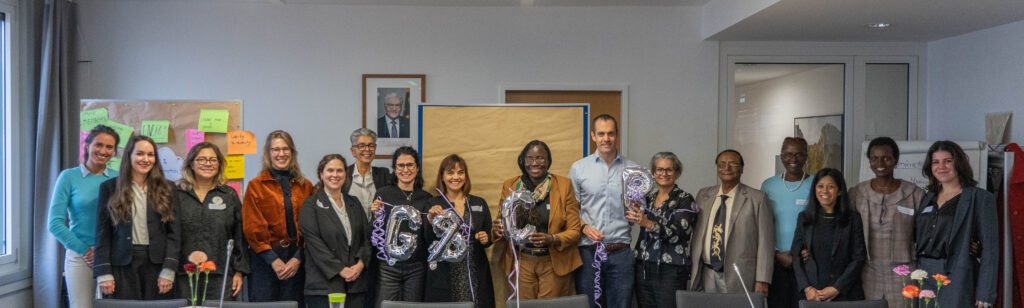
The G&CP is structured as a multi-stakeholder partnership (MSP). Such partnerships bring together actors from at least three sectors — government, industry, business, civil society and academia — to work together over the long term, on an equal footing, towards a common goal that serves the public interest. This collaborative approach makes MSPs particularly well suited to addressing complex, cross-sectoral challenges such as gender-responsive chemicals management.
Following the establishment of the G&CP, the initial focus was on laying the structural foundations for effective collaboration. At its first annual Assembly in 2024, a representative Board and Working Group Co-Chairs were elected, a governance document was adopted, and common objectives were agreed upon. Since then, four working groups have been active, focusing on gender data and information, international policy processes, education and training, and national and regional implementation. The partnership’s work is coordinated by a Secretariat hosted by the MSP Institute.
What began as a small group of founding members has since developed into a partnership comprising 29 partners from different sectors and regions of the world. The G&CP is increasingly visible internationally and strengthens gender perspectives through side events and participation in processes such as the GFC, ISP-CWP and the United Nations Environment Assembly. The broad participation of different stakeholder groups in our events demonstrates that the gender-responsive chemicals management enjoys support beyond individual interest groups. At the same time, the G&CP provides a space for strategic exchange, fosters a shared understanding of important terminology, and highlights the benefits of gender-responsive chemicals management.
Early milestones include contributing to the draft GFC Gender Action Plan, which will be considered for adoption at the first International Conference of the GFC (GFC IC1) in November 2026, and launching the Gender & Chemicals Knowledge Platform in July 2026. For the first time, this platform brings together knowledge at the intersection of gender and chemicals, promoting the exchange of data, good practice examples and practical implementation resources. Alongside this, through a training project for European focal points for the GFC and ISP-CWP, the G&CP also builds knowledge of gender and multi-stakeholder approaches, while supporting national implementation efforts and fostering networking among those involved.
Between Ambition and Capacity Constraints
These first steps have only been possible thanks to the exceptional commitment of many individual members who care deeply about gender-responsive chemicals management and have invested considerable time and energy. The diversity of stakeholders is one of the G&CP’s greatest strengths, but it also presents challenges. Bringing together different areas of expertise, working methods and expectations takes time and patience. For many members, participation is an additional responsibility alongside their regular work. Changing roles and new members joining the initiative also mean that people need time to find their place within the partnership. At the same time, it is not always easy to make the partnership’s impact visible and measurable — particularly when its contribution lies in bringing people together or influencing policy processes over the long term.
Financial resources are also limited. A wide range of ideas must be pursued with project-based funding that is not designed to support long-term multi-stakeholder collaboration. The increasingly difficult political climate further exacerbates this challenge. One of the central tasks, therefore, is to bring the G&CP’s ambitious goals into line with the capacities and resources available.
Learning from Experience, Shaping The Future
One important lesson from the first years is that concrete, achievable steps and clearly defined roles are essential. Going forward, a shared work plan and a theory of change will help the partnership set priorities, coordinate its working groups and make its contribution more visible. At the same time, a multi-stakeholder partnership needs time to build and maintain relationships. Valuing people’s contributions and fostering personal connections are essential prerequisites for sustained commitment. Especially given the tense political climate, it is important to organise participation in ways that remain effective and motivating without overburdening those involved.
Going forward, this means further strengthening the G&CP’s substantive work and organisational capacities. This includes attracting new partners of strategic importance, expanding cooperation with the scientific community — for example, through the ISP-CWP — and helping shift political debates, which are often driven by ideology, towards a stronger focus on scientific evidence. Another priority is to integrate gender more effectively into national implementation programmes. The G&CP can support this by facilitating the exchange of experience, adapting approaches to national contexts and helping to embed gender perspectives in institutional structures.
Despite the challenges, the G&CP is well equipped to achieve these goals, thanks to its committed members, the trust it has built over time, a common strategy and, above all, a shared vision: a world in which gender equality is an integral part of chemicals and waste management.